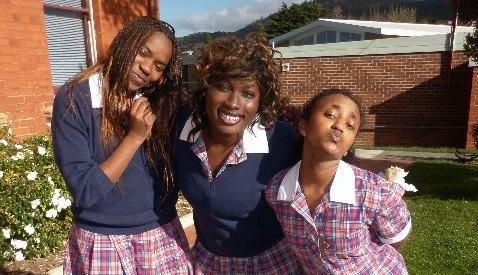
Sharon's story
I was born in Kenya. I grew up in a village, about eight hours away from Nairobi, which is the main city. The Friends’ School in Hobart was very generous and would provide books and a lot of materials to our Friends School in Kenya. At one point they sent books and asked if someone was interested in writing, and I wrote back just to say thank you. My mom used to be a librarian sometimes, so I was just interested in books and I was keen.
They sent a few more books back. I remember one of the books they sent was Looking for Alibrandi. I remember reading that and then responding, and that’s how our conversation started. I was 15 at the time.
If I wrote something, I would give it to my parents to then organise. We didn’t have the internet at all. My parents would have to go to the nearest town, go to a cyber café, — so all my correspondence was just through my parents and this conversation kept growing.
I remember my parents came to school one day and told me, “We’ve heard back and they’re offering you a scholarship to study at The Friends’ School in Hobart. What do you think?” And I was like, what do you mean? Of course I’ll go. And luckily, they didn’t hesitate either. This was unheard of, and I was pretty much the first person in my village to have that sort of experience.
Teachers from the Friends’ School had got together – [past teacher] Greg Hill and [current Head of Senior School] Adam Chambers were involved – and arranged to offer me the scholarship.
To be honest, I really believe in God — to me it felt like some sort of divine intervention or favour. I didn’t even expect it. I didn’t know what it was about. We didn’t have access to the internet either, so you can imagine my knowledge of Australia or any of that was very limited.
I arrived in Tasmania in 2009. I was ready to go. I was so excited. I had barely even gone to the main city of Nairobi growing up, so to have that opportunity — I was just excited. I never thought, oh, I’m moving so far away from my parents. None of that occurred to me until I was here, maybe six months in, and then I thought: oh, I’m actually away from home.
I travelled to Nairobi via bus, and then from Nairobi I came on my own, and this was all organised by Friends’. I came as an unaccompanied minor to Melbourne, and then in Melbourne I met Greg Hill. And then we took the flight to Hobart.
On the way there I started having, you know, when your ears are painful from the pressure — I remember Greg giving me mints. “Here, take this, this will help.” So Greg was the very first person I met. He dropped me at the boarding house, but made sure I had clothes, I had books, I had everything that I needed while at the boarding house.
Oh my goodness — I know this sounds like a cliché, but coming to The Friends’ School was life changing. Coming from a village where I had hopes and dreams of finishing high school and getting into Uni — but that would have been dependent on a lot of things, like my parents being able to afford the fees.
So to then have the opportunity to have all my high school education paid for, a good education — I came in and I was handed a laptop. You can imagine, I had never seen a laptop before. That exposed me to a lot of things. It really opened up my mind — critical thinking, things like that. I did the IB in Years 11 and 12. It was really good.
I made lifelong friends that I’m still friends with. And not even that, but also just the fact that once I finished school, it gave me the opportunity to move to WA, get into Uni, finish Uni, get a job here — my life changed.
I moved to WA after I finished Year 12 and stayed with a few friends, because I didn’t want to go back to Kenya and have my parents, who had other siblings to support, worrying about how to put me through Uni. I remember Greg and some of the teachers trying really hard to help me apply for scholarships for Uni. Unfortunately I didn’t get one, but it was still okay because I had a plan B.
When I moved there, my friend helped me get a part-time job, and for a while I just worked while I got my fees together for Uni. I applied for a student visa, which I got, and then went through nursing school for three years. Because I was working and paying my own fees, after I finished I got a job and was able to help my parents with school fees for my siblings back in Kenya.
From that gesture of sending books — it may seem small, but that was a very big thing for me. From that, I’ve been able to support my siblings’ education in Kenya and I’ve been able to bring over my sister to Perth to do her Masters, and I’ve done my Masters too. I can’t even describe it. It’s too great to put into words. And then after I finished, I met my husband Robert. From all of that — it’s really opened a lot of doors for me, and for my family.
It is really a blessing to have the quality of education they have in Australia, and it’s something not to take for granted. It really isn’t. It opens your mind and opens a lot of doors and opportunities. I would say make good use of it, and don’t take it for granted.
I never really got a chance to say thank you to everyone who was involved. When I was there — Mr Green was the Principal, and all the teachers: Adam, Robin who used to teach English, and so many others who were very kind to me and really did their best to make sure I settled in and had everything I needed.
During short school holidays I would go to some of the parents who would volunteer to have me. There were so many people who contributed to my journey to where I am right now. I may never have said thank you to all of them, but it’s something I pray and thank God for every single day of my life.
I really hope my story can speak to people, speak to their heart. Because you might think that your contribution is very little, but what you don’t know is the seed it’s planting. You don’t know how it can change someone’s life.
In Swahili, we have this saying: kidogo kidogo hujaza kibaba.
It basically means ‘little by little leads to something bigger’.
I believe when you give, it always comes back to you. Generosity is a big thing. It changes the lives of people around you. I just hope someone else may have a life-changing opportunity like me. And it does change lives — it changes generations to come. That’s something to be proud of.