Zarifa's story
My name is Zarifa Alizada. I’m from Afghanistan, and I left almost 8 years ago now.
In 2019, my family decided to move somewhere safer — somewhere that offered future opportunities for the girls in the family to continue their education, to go to university. That was the main reason my parents decided to move. I have two older sisters, and equality wasn’t really a thing back in Afghanistan, so that’s why we left.
We moved to India first, stayed there for a couple of weeks until we got our visa for Malaysia, and then we moved there and stayed for about 4.5 years. It was a tough time, but it also taught us some of the most important lessons — as a family and as individuals.
Living as a refugee was our first experience of that kind of life. Back in Afghanistan, my father had his own business as a goldsmith, and we were living at a comfortable, middle level of society. Things were good. But once we moved, since my parents couldn’t speak English, that was one of the toughest things for us as a family. My father wasn’t able to find the kind of work he wanted. He had been independent from a very young age, and suddenly he wasn’t able to continue his business or find a proper job and earn an income.
Most of us children were young at the time. We’re a big family — I have 9 siblings, 5 sisters and 5 brothers. Actually, my youngest brother was born in Malaysia, so he’s sort of Malaysian as well!
At first, that first year, it was tough — missing home and the life we used to live. But we managed it, looking back now. There was some community around us in Malaysia, but not a great deal of organised support from organisations.
In the first two years I went to a school called the Malaysia International Korean School, which was essentially a refugee school — almost all of the students there were refugees from various countries. Then COVID came and changed everything. We were in lockdown for 2021 and 2022. For the first six months there were no classes at all, and then we had online learning, which wasn’t really effective — especially for me, since I was still learning English at the time. Online learning honestly isn’t that effective for most students, but we got through it.
We eventually got a humanitarian visa from Australia — the whole family, which was really wonderful. We chose Tasmania because my oldest brother had been living there for about 10 years. He’d actually come to Australia by boat when he was 16, and he really made the best of his time in Tasmania. He’s always been an inspiration to me, in terms of continuing on an academic journey and pursuing further education.
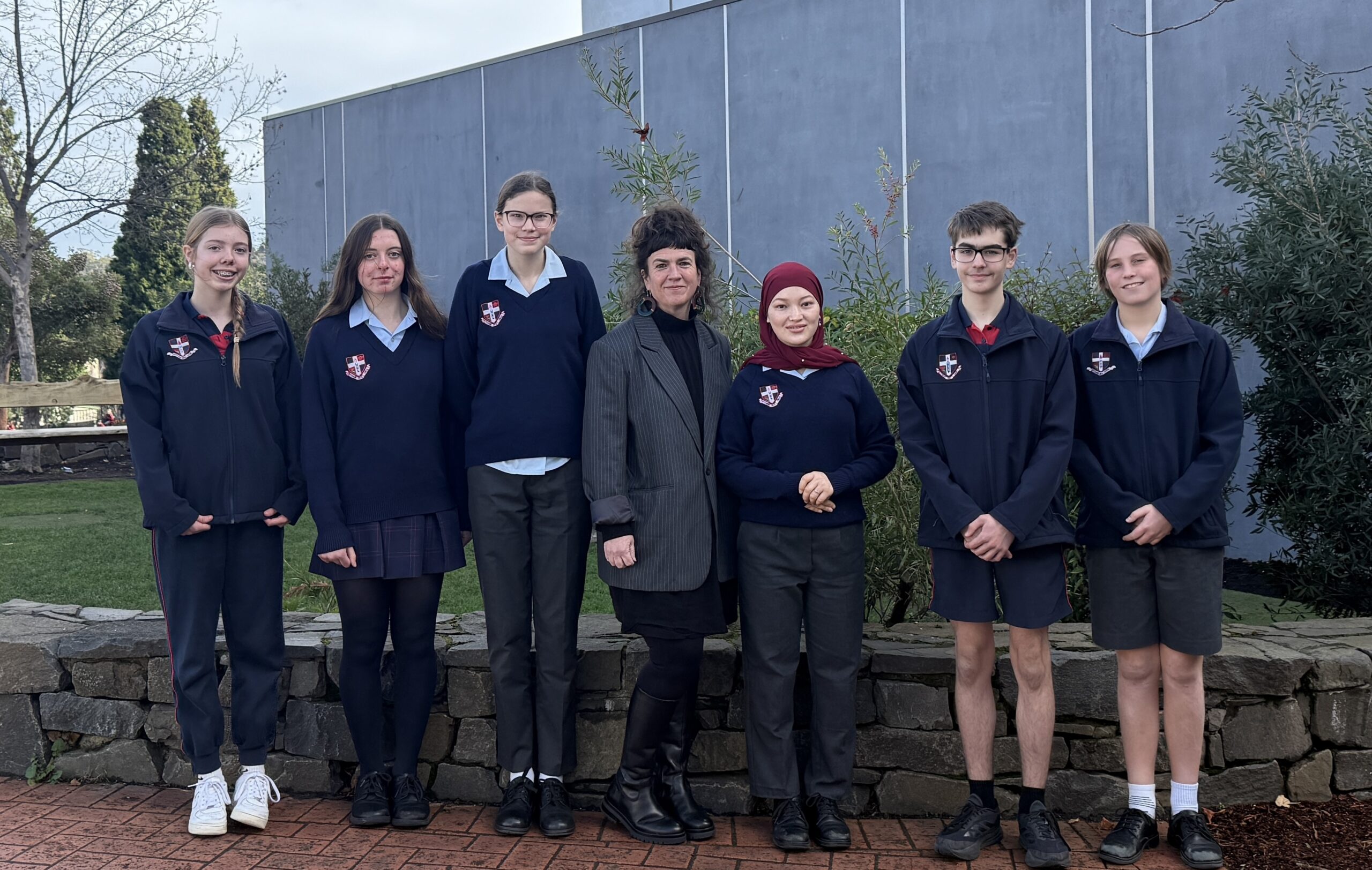
We arrived in Tasmania in 2023. I had actually researched schools in Hobart even before leaving Malaysia, and Friends’ School was one of them. I applied for a scholarship at Friends’, and after submitting documents and going through an interview with Principal Nelson File and Adam Chambers, I was accepted on a refugee scholarship.
When I received the letter by email, I opened it immediately — but I only read the first part, which said they couldn’t offer me the scholarship I’d applied for. I was devastated and closed it. But a few minutes later I opened it again to make sure I’d read it correctly, and that’s when I saw the second part: they were offering me a refugee scholarship instead. I was shocked, surprised, and so excited. When I reflected on my whole journey — all the schools I’d attended in Malaysia — I felt deeply grateful.
In terms of holding onto culture and identity through all of that — culture has always been deep in our hearts as a family. We were raised with education as a true priority. I’m from the Hazara ethnic group in Afghanistan, and education has always been central to Hazara values — though unfortunately within Afghanistan we didn’t have much political power, and our schools would sometimes be shut down or bombed because of our beliefs and ideology. That commitment to education gave us the active hope to keep fighting for it.
When I arrived at Friends’, it was a struggle at first. Because of COVID and the disrupted schooling in Malaysia, I didn’t have the foundational knowledge — the basics of academic writing and so on — that most year 11 students would have. English was also a significant challenge. The way I speak now is very different from how I spoke two years ago. So my first focus was improving my English — I studied ELD at Friends’ in 2024, which really helped. Once I had a stronger foundation in English, I was able to tackle everything else.
If I had to summarise what Friends’ gave me in a few words, it would be: active hope and the idea of giving back to community. Being given that scholarship made me feel a deep responsibility to give something back. It gave me the idea and the motivation to study something through which I could genuinely help others.
At the moment I’m a student at the University of Queensland, studying a Bachelor of International Studies, majoring in Peace and Conflict Studies as well as Spanish. I’d always wanted to learn Spanish, so I was happy when the opportunity came. That actually brings me to 5 or 6 languages — my native language is Dari, and I also speak Pashtu since I was born in Afghanistan. I picked up Turkish during COVID by watching Turkish dramas, so I can understand it fully and speak it reasonably well. And since we’re Muslim, I learned to read Arabic through the Quran as well, so I understand a good amount of that too.
In terms of how my education has changed the lives of those around me — I’m always motivating my younger siblings. I have two younger sisters and two younger brothers, one sister in year 9, and the others in years 6 and 5. I’m always telling them to use the time they have now, because I didn’t have the proper high school experience they’re getting. I encourage them to study hard, perhaps aim for a scholarship at a good school in Brisbane. My father also uses my journey as an example to motivate them. They’ve been really inspired, I think, and that means a great deal to me.
All of my family is now in Brisbane — including my oldest brother, who my mother eventually convinced to move up from Tasmania. For us, family unity and harmony is everything. Even though some of my siblings are now married and living separately, we try to get together every Saturday and Sunday — we go out, and we have a family book club where we each talk about what we’ve been reading and discuss it together. It’s a way of staying connected and also keeping our culture alive.
If I could say something to people who have always had access to stable education, it would be this: please appreciate the opportunities you have. At some Schools I saw students ignoring or wasting what they had — not appreciating the school, the equipment, the access. It was hard to watch. Please make good use of what you have.
And if I think about what I hope people take from my story — it’s simply: don’t give up. Hold onto that active hope within your heart. Keep fighting for it. Try to do something useful for your future, and something that gives back to your community. Appreciate what you have.
When I see women in Afghanistan today — girls my age, people I grew up with — who have no access to education beyond primary school, who are just at home with nothing, it devastates me. But it also pushes me. Since I have this opportunity, I can’t waste it. I have to make the very best of it — for myself, and for them.
My parents are honestly my greatest role models. Imagine moving to a completely different country — different language, different culture, different system — with all your children, not knowing what lay ahead. My father’s business had been going really well back in Afghanistan, and the only reason they left was for our education. That takes enormous courage. Since arriving in Brisbane, we’ve all been working hard, and we now have our own home. We’re still adjusting to the Australian system and the language, but we’re making the most of every opportunity.
To anyone who hears my story — have that active hope within you. Make the best out of what you have today. That’s what I want to say.